What We Pass On
Aug 29, 2026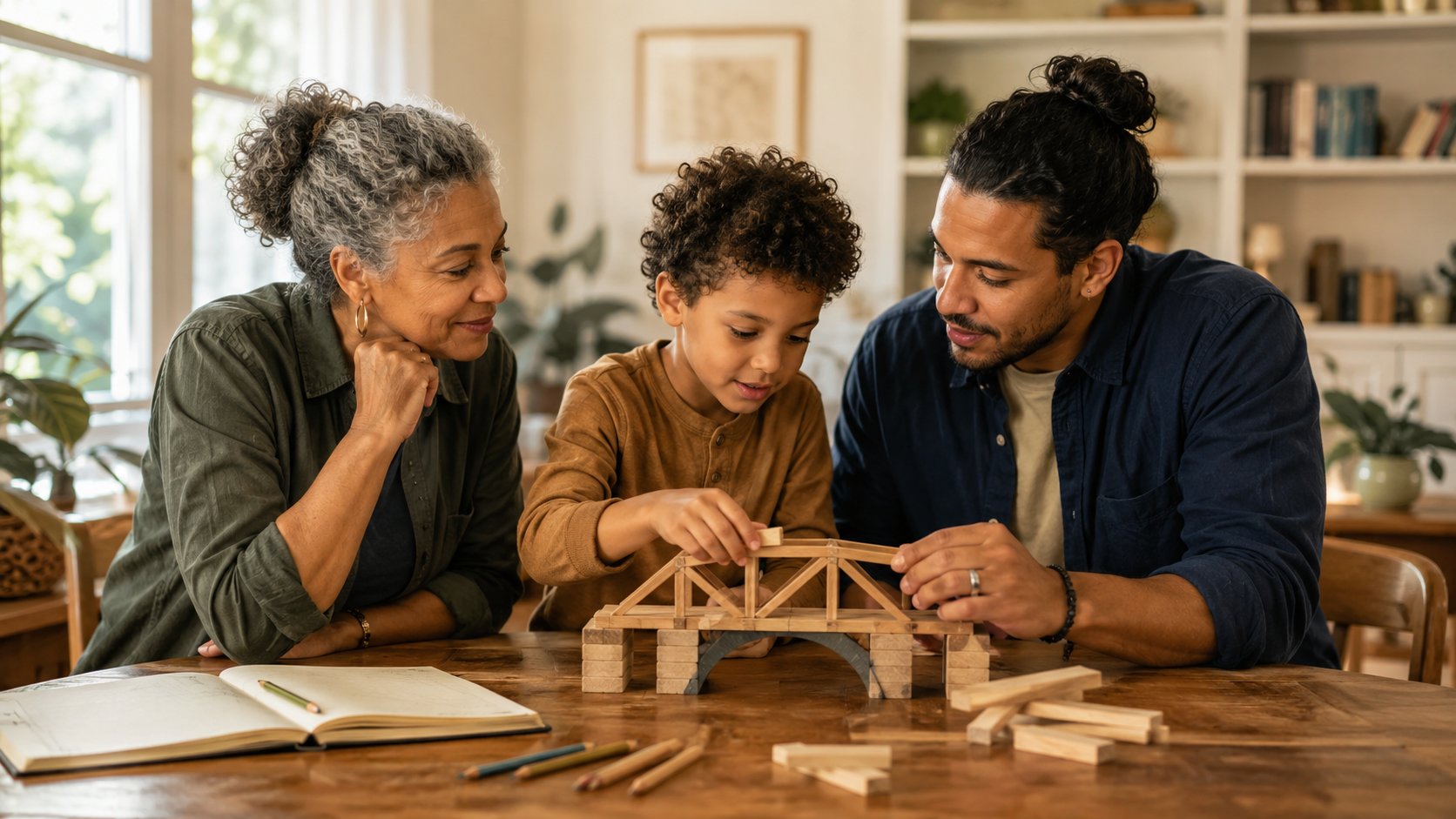
CHILDREN & FAMILIES RESOURCE
What We Pass On
Helping Children Build the Inner Tools for Life
By William E. Carpenter
|
A gentler approach to nurturing awareness, thoughtful questions, emotional steadiness, loving choices, and meaningful connection |
EXECUTIVE EDITION • AUGUST 2026
Reader Orientation
This essay is written for parents, caregivers, educators, and other adults who support children. It offers a reflective framework for family learning—not a formula for perfect parenting.
|
A note on development |
At a Glance
|
What adults model Children learn not only from what adults teach, but from how we listen, disagree, use authority, and repair. |
Identity and behavior A child’s choices matter, but a mistake need not become a final judgment about the child’s worth. |
|
Inner tools in daily life Pause, Notice, Ask, Choose, and Practice can become part of play, conflict, stories, boundaries, and ordinary conversation. |
Questions and relationship Sincere questions create space for clearer perception, responsibility, belonging, and a more thoughtful next choice. |
Contents
Every Generation Enters an Unfinished World
New Eyes and Established Ways
Seeing Ourselves and the Child Differently
What Is Developing Beneath the Surface
The Adult as Guide, Environment, and Fellow Learner
Family Life as a Living Curriculum
Difference, Belonging, and the Power of Joining
Stories as Rehearsal for a Gentler Dream
The Gentler Dream Begins in Ordinary Moments
In the spring of 1993, my five-year-old son Christian and I were wrestling on our living-room floor. At some point, tired and laughing, we rolled onto our backs beneath the skylight. It was a beautiful morning. The sky above us was clear and blue, and I was content simply to enjoy the moment.
Christian had gone somewhere deeper.
Looking through the skylight, he asked, “I wonder what is really out there in the world? Not just here, but really out there?”
I slowly turned my head toward him. My first thought was, “What is this kid thinking?” I did not have a profound answer ready. I simply said, “Maybe you will find out someday.”
Neither of us knew how soon the world beyond that skylight would enter our lives. Later that year, I accepted a position in Al-Khobar, Saudi Arabia. For the next seven years, I worked abroad for stretches of three to six months before returning home. Our family eventually visited Saudi Arabia, and the experience changed how all of us saw people, culture, distance, difference, and possibility. Christian later joined the United States Air Force and saw many more countries. Today he is married and raising two sons, Beau and Cole, who are six and five and already beginning adventures of their own.
I still return to that morning beneath the skylight. A child’s sincere question opened a window long before any of us knew where it might lead.
|
A question worth carrying |
Every Generation Enters an Unfinished World
Every child enters a world already shaped by earlier generations. Before children can name a belief, understand a tradition, or question a rule, they are surrounded by ways of seeing and living handed down over time.
They inherit language, knowledge, family stories, spiritual traditions, customs, skills, and hard-earned wisdom. They may also inherit fears, divisions, assumptions, grievances, and habits no one has examined for many years.
Children learn from what adults deliberately teach them. They also learn from how we listen, how we disagree, how we respond to unfamiliar people, how we exercise authority, and how we repair the harm we cause. They notice whose voice is welcomed and whose is dismissed. They notice whether questions bring curiosity or irritation. They notice whether a mistake becomes an opportunity to learn or a reason to feel ashamed.
This does not mean we should discard everything old or celebrate everything new. New generations are not automatically wiser than the generations preceding them. Earlier generations carry experience, perseverance, craftsmanship, faith, stories, and knowledge gained through real difficulty. New generations bring fresh questions, emerging knowledge, and eyes not yet fixed on only one way of doing things.
Human development needs both. Our task is not to reject what came before or demand that children preserve it unchanged. It is to help each generation receive, examine, practice, and improve what humanity has learned.
Cultures are not passed from one generation to another like sealed packages. They are retold, interpreted, tested, and sometimes transformed through interaction, innovation, cooperation, and story.[1] Transformation often begins quietly, in relationships, long before it becomes visible in a school, organization, community, or nation.
New Eyes and Established Ways
I witnessed this dynamic during my years in Saudi Arabia.
I worked as an on-site electrical and instrumentation superintendent while oil, gas, refining, and storage facilities were being upgraded. My responsibilities brought me into regular construction-management meetings with Saudi Aramco managers, engineers, designers, outside contractors, and professionals from several nations.
Saudi Arabia was pursuing the long-term process commonly called Saudization—preparing Saudi citizens to assume positions that expatriate professionals had held for decades. Young Saudi graduates were returning from universities worldwide and entering important technical and managerial roles. Many brought excellent education and a new vision for their country, but some had limited field experience. At the same time, many Western professionals had decades of practical knowledge but had become accustomed to established arrangements and expectations.
The transition produced real tension. Some experienced people felt displaced or unheard. Some newer people were asked to carry authority before they had accumulated the judgment that comes only through experience. Neither group possessed everything the situation required.
As additional Saudi and international professionals arrived, however, I noticed something important. Newcomers were not carrying the same history of frustration. They entered the circumstances as they were, adapted, built relationships, and started from a different point. Their new eyes did not erase the value of experience, but they changed what seemed fixed or inevitable.
That experience taught me that cultures change when inherited wisdom and new perception can meet without either side believing it has nothing to learn. The same principle applies within families. Children need adults’ protection, experience, and guidance. Adults also need the questions, perceptions, and possibilities children bring into the world.
We should not burden children with the responsibility of rescuing humanity. We can, however, give them relationships and tools that help them participate thoughtfully in humanity’s continuing development. We can help them inherit our wisdom without requiring them to inherit every limitation in our way of seeing.
Seeing Ourselves and the Child Differently
This work begins with perception.
Children are not empty containers waiting for adults to fill them. They are not problems to repair, personalities to control, or projects through which adults prove their success. Adults are not finished people standing above unfinished children. We are all learning how to see, relate, choose, and begin again.
A Course in Miracles has profoundly influenced how I understand this relationship. One recurring teaching is that our deeper identity is not manufactured by the world or destroyed by our mistakes. In
the Course’s language, “I am as God created me.”[5] I understand this to mean that our true Identity, created by Love, remains whole beneath the fears, roles, defenses, and stories we acquire.
Adults do not give children their worth or create their true identity. We can remind them of their worth and help create conditions in which they recognize and express it. We can teach children that a mistake is something to examine and repair—not proof that they are bad. We can help them distinguish between who they are and what they are doing right now.
That distinction does not remove responsibility. Behavior matters. Children need structure, protection, honest feedback, and boundaries. Harmful behavior may require immediate intervention. Loving perception does not mean overlooking harm. It means correcting behavior without making it the child’s identity.
Our interpretations influence how we respond. When we decide that a child is selfish, dishonest, manipulative, lazy, or difficult, we begin responding to the label as much as to the child. When we pause and look again, we may discover fear, confusion, fatigue, unmet needs, missing skills, a different interpretation, or an attempt to belong.
Looking again does not excuse what happened. It allows correction to serve safety, learning, responsibility, and repair rather than humiliation or rejection. This is forgiveness in practice: releasing an interpretation that keeps us from seeing more clearly and responding more lovingly.
What Is Developing Beneath the Surface
Children between approximately three and eight years old are developing capacities that adults often take for granted. They are learning to recognize feelings, direct attention, remember instructions, pause before acting, consider consequences, understand ownership, take turns, participate in groups, hear another perspective, and repair relationships.
These capacities do not appear all at once. They develop unevenly through experience, relationship, play, language, repetition, and support. Temperament, culture, neurodevelopment, safety, fatigue, stress, opportunity, and the child’s familiarity with a situation all affect what we see at a particular moment.
For children around ages three to five, learning is highly relational and concrete. A young child may need an adult’s calm presence before they can calm down. Pictures, play, repetition, short questions, modeling, and simple choices are often more useful than lengthy explanations. Children may experience an inner capacity before they can describe it. They are learning what belongs to them and others, how turns work, why groups need agreements, and how their wishes coexist with other people’s needs.
Responsive, back-and-forth exchanges with caring adults help establish foundations for language, emotional development, and increasingly complex social and cognitive abilities.[2] The exchange itself matters: the child expresses something, the adult notices and responds, and the child learns that communication and relationship have meaning.
By approximately ages six to eight, many children can engage with more complex stories, compare motives, anticipate consequences, consider different perspectives, and discuss what a character believed. Their understanding is still developing, but stories can provide a safe place to rehearse choices and examine interpretations.
A three-year-old may need help naming what happened. An eight-year-old may be ready to examine the story formed about what happened. Both are learning to look again.
Developmental descriptions should never become rigid checklists we use to judge children or ourselves. A child who cannot yet use a skill consistently is not necessarily defiant or deficient. Executive function and self-regulation develop over an extended period and are strengthened through practice and supportive environments.[3] Adults therefore need expectations that are hopeful and appropriately matched to a child’s present capacities.
The Adult as Guide, Environment, and Fellow Learner
Children learn as much from the way adults respond as from the words adults use.
Adults retain responsibility for safety, structure, boundaries, and age-appropriate decisions. Listening to children does not mean handing them every decision or pretending that adults and children possess identical responsibility. It means recognizing children as participants in family and community life. Their perceptions can be heard and taken seriously even when the final decision must remain with an adult.
Meaningful participation grows through mutual respect, dialogue, support, and age-appropriate opportunities to contribute.[4] When a child’s preference cannot be followed, an explanation still communicates respect: “I heard what you wanted. Here is why we need to do something different.”
The adult’s inner condition matters. A frightened or overwhelmed child may not be ready for reasoning. Co-regulation often comes first: a calmer voice, a safe physical presence, fewer words, and time for the nervous system to settle. Calm limits and warmth can coexist.
Adults will sometimes react badly, misinterpret what happened, or use words we wish we could retrieve. Repairing our own mistakes teaches something essential. We can say, “I was frustrated, and I spoke harshly. That was not the way I want to speak to you. Let’s begin again.” Authority does not become weaker when it is honest. It becomes more trustworthy.
Before we ask children to pause, notice, question, and choose again, we must become increasingly willing to practice those movements ourselves.
This is not easy in every circumstance. Families throughout the world are raising children amid financial hardship, war, displacement, illness, discrimination, disability, grief, isolation, and inadequate support. Inner tools do not make these conditions imaginary, nor do they place all responsibility upon individuals. They can help us meet reality with greater steadiness and connection while we also work to change conditions that cause harm.
Family Life as a Living Curriculum
The Inner Toolbox presents five movements that adults and children can practice together:
Pause • Notice • Ask • Choose • Practice
These practices are not reserved for emergencies. They can become a natural way of participating in play, meals, stories, games, household responsibilities, creative projects, celebrations, unfamiliar experiences, disagreements, apologies, and ordinary conversation.
Imagine two children building a bridge from wooden blocks. One child has carefully planned the structure. The other reaches across, moves several blocks, and part of the bridge collapses.
“You ruined it!” the first child shouts, grabbing the blocks away.
An adult could immediately demand an apology or decide which child is at fault. Instead, the adult pauses, comes closer, and helps everyone become still enough to speak.
“I can see that something important happened,” the adult says. “Tell me what each of you was trying to do.”
The first child explains the plan. The second says, “I was trying to make it stronger.”
Now something new becomes visible. The same action that looked like destruction to one child was intended as help by the other. The hurt and the grabbing still need attention, but the story has widened.
The adult might ask, “What are you noticing now? What could we do with the bridge? What would help both of you feel included?”
Perhaps the children decide to rebuild together. Perhaps they create two structures and connect them. Perhaps one needs a few minutes before continuing. There is no single perfect ending. The value lies in creating enough space for a different understanding and a more thoughtful choice.
That brief interaction contains the whole toolbox:
Pause: Make room between the first reaction and the next response.
Notice: Attend to feelings, bodily signals, assumptions, needs, and what appears to be happening.
Ask: Move from accusation or certainty toward sincere curiosity.
Choose: Identify the next honest, safe, kind, and constructive step.
Practice: Repeat the process, including when we forget and need to repair.
For younger children, the movement may be even simpler: Notice. Wonder. Feel and pause. Look again. Choose and repair.
The goal is not to turn every interaction into an interrogation or therapy session. Sometimes children need room to play without adult commentary. Sometimes the wisest response is a boundary, a hug, practical help, shared laughter, or quiet companionship. The toolbox is not a script. It is a way of becoming more present and less governed by our first interpretation.
Over time, what we repeatedly practice becomes part of family culture. Curiosity becomes more natural. Listening deepens. Repair becomes less threatening. Children and adults learn that the first reaction does not have to become the final choice.
Difference, Belonging, and the Power of Joining
Families and communities are not built by eliminating difference. They are built by learning how to live with difference without automatically converting it into fear, superiority, or separation.
Children encounter differences in appearance, language, customs, beliefs, abilities, family structures, personalities, opportunities, and ways of understanding the world. Adults teach children what these differences mean—often without saying a word.
Tolerance may be a beginning, but understanding and appreciation take us further. We can help children ask, “What can I learn here?” rather than “Why is this person not like me?” We can teach that cooperation does not require complete agreement and that belonging should not demand sameness.
Joining does not require us to erase our differences. It asks us to stop using difference as proof that separation, fear, or hostility is inevitable.
For this work, family includes many forms of caring relationship: parents, grandparents, extended families, guardians, adoptive and foster families, teachers, community elders, coaches, and other adults who help children grow. No single cultural or family pattern can contain all human wisdom. A global community grows when we remain rooted enough to share what we know and open enough to receive what another person can teach us.
Good questions build bridges across these differences. They slow judgment and make another person’s world more visible. They allow new eyes and established experience to meet without requiring either to disappear.
Stories as Rehearsal for a Gentler Dream
Children have always learned through stories. Stories allow them to enter circumstances they have not personally experienced and explore them from a place of relative safety. Through a character, a child can encounter fear without being accused, make a mistake without being defined by it, and consider another choice without first suffering every possible consequence.
The first three Inner Toolbox stories were created to accompany these conversations.
The Map in the Toolbox explores perception, inner guidance, thoughtful questioning, and the discovery that a wiser direction may become visible when we pause and look again.
The Broken Circuit explores uncertainty, fear, cooperation, resilience, and what happens when familiar sources of security are disrupted. Its characters begin to discover what truly helps when circumstances do not unfold as expected.
The Book of Questions develops listening, curiosity, perspective-taking, and connection. Its central idea is that good questions build bridges—between people, possibilities, and different ways of seeing.
The books are not designed to fix children or provide a correct answer for every situation. They create shared spaces in which children and adults can wonder together.
Adults do not need to turn a story into an examination. We do not have to ask ten questions to prove that the child understood the lesson. Sometimes the most powerful invitation is simply, “I wonder what you noticed.” Then we listen and let the story keep working after the book is closed.
The Gentler Dream Begins in Ordinary Moments
The goal of this work is not perfect children, perfect parents, or perfectly peaceful families. The goal is to remember more fully who we are and to experience and extend more peace, joy, and love.
A Course in Miracles describes a movement away from a world interpreted primarily through fear and separation toward what it calls a happy dream. Elsewhere, the Course speaks of a gentler dream. I understand that movement not as an escape from life, but as a different way of meeting it. The gentler dream is practiced whenever we refuse to make fear our only teacher; whenever we look again before condemning; whenever we tell the truth without withdrawing love; whenever we use authority to protect rather than dominate; and whenever we repair rather than permanently define one another by a mistake.
Every moment—not only every difficult moment—can become part of this curriculum. It is present when a child wonders aloud beneath a skylight, when two children negotiate the rules of a game, when a family welcomes someone different, when an adult admits an error, and when a question opens a possibility no one had considered before.
Children should not carry the burden of rescuing humanity. Adults can provide relationships, tools, stories, and environments that help a new generation participate wisely in humanity’s continuing development. We can offer children what we have learned while remaining willing to learn from what they see.
Every generation receives a world it did not create alone. Each also contributes to the world that comes next. What we pass on will be shaped not only by what we tell children, but by how we see them, how we listen to them, what we practice with them, and what we become willing to question within ourselves.
Christian’s question beneath the skylight did not need an immediate answer. It needed room. Years later, his sons are looking into a world of their own. I cannot know where their questions will lead, but I know what I want to help create around them: a space where questions are welcomed, identity is not reduced to behavior, differences become invitations, and choosing again is always possible.
You might begin with a few minutes of quiet. Become still enough to notice what occupies your mind and where you place your attention. Hold one open-ended question without demanding an immediate answer:
|
A closing reflection |
Remain open to what becomes visible over time.
Then, in your next ordinary moment with a child, pause long enough to become fully present. Notice what the child is exploring. Ask one sincere question without deciding in advance what the answer should be. Listen for what the child is learning—and for what the moment may be inviting you to learn together.
That is one way a gentler dream begins.
Continue the Journey
Explore stories, essays, and practical resources designed to help children and the adults who care for them practice curiosity, emotional steadiness, loving choices, and meaningful connection.
Notes and Sources
1. Lucas M. Bietti, Olivier Bangerter, and Adrian Mayor, “Cultural Transmission in a Food Preparation Task: The Role of Interactivity and Storytelling,” PLOS ONE 14, no. 9 (2019). Source
2. Center on the Developing Child at Harvard University, “Serve and Return: Back-and-Forth Exchanges.” Source
3. Center on the Developing Child at Harvard University, “A Guide to Executive Function.” Source
4. UNICEF Office of Research—Innocenti, “Why Participation Matters.” Source
5. A Course in Miracles, Workbook for Students, Lesson 94, “I am as God created me,” Third Edition, Foundation for Inner Peace.
Publication Notes and Terms
A Note on Sources, Interpretation, and Independence
This essay is an original educational interpretation by William E. Carpenter, informed by his study and practical application of A Course in Miracles and written for parents, caregivers, educators, families, and other adults who support children. It is not an official commentary, authorized curriculum, or definitive statement of the Course’s teachings. Readers are encouraged to study the original material and reach their own conclusions.
ACIM Global Coach, LLC, and William E. Carpenter are not affiliated with, endorsed by, or sponsored by the publishers, foundations, organizations, or other entities associated with A Course in Miracles. Quotations and referenced third-party materials remain the property of their respective rights holders and are used for commentary, education, scholarship, or with permission where applicable.
Course source: A Course in Miracles, Third Edition, Foundation for Inner Peace.
Copyright and Intellectual Property
Copyright © 2026 William E. Carpenter. Published by ACIM Global Coach, LLC. All rights reserved.
What We Pass On: Helping Children Build the Inner Tools for Life—including its original text, personal narratives, family-learning examples, Children & Families educational architecture, and the original selection, coordination, arrangement, and expression of the Inner Toolbox applications contained within it—is the intellectual property of William E. Carpenter.
No part of this publication may be reproduced, distributed, transmitted, adapted, republished, stored in a retrieval system, or incorporated into commercial educational, training, publishing, or derivative materials in any form or by any means without prior written permission, except for brief quotations with appropriate attribution and other uses permitted by applicable law.
Permissions: [email protected]
Educational and Professional Disclaimer
This publication is intended for educational, reflective, and family-conversation purposes. It is not medical, psychological, developmental, psychiatric, therapeutic, educational-diagnostic, or legal advice, and it is not a substitute for individualized guidance from a qualified pediatric, mental-health, developmental, educational, or legal professional.
Developmental observations are general and should not be used as rigid checklists or diagnoses. Spiritual and philosophical ideas are offered as possibilities for personal consideration, not as scientific or clinical conclusions. Loving perception does not require overlooking harm: protect children, establish appropriate boundaries, and seek qualified or emergency assistance when safety may be at risk.
Parents, guardians, caregivers, and educators remain responsible for determining whether any activity, story, question, or practice is appropriate for a particular child’s age, development, abilities, circumstances, and safety needs.
For complete terms, read the full Educational Disclaimer.
